neo.js.cn@gmail.com

Fabric Quotation · Built for PMC Manufacturers
CPQ & Application Engineering Software for Paper Machine Clothing Manufacturers
Connect sales, application engineering and pricing in one structured quotation workflow — from paper machine position and fabric selection to design recommendation, pricing, discount approval and quotation.
Still Managing Fabric Quotations with Excel, Email and Manual Engineering Handoffs?
For a paper machine clothing manufacturer, a quotation depends on the customer’s machine, operating position, fabric design and commercial rules. When these details live in separate files and conversations, every handoff adds work.
- Product and machine information is scattered across Excel files.
- Sales relies on experienced application engineers to select the correct fabric.
- Technical recommendations move through email and informal conversations.
- Pricing rules and historical prices are difficult to apply consistently.
- Discount requests have no clear approval trail.
- Revised quotations are difficult to compare and trace.
- Critical application knowledge stays with a few experienced employees.
Fabric Quotation brings that information and those decisions into a shared process for Sales, Application Engineering and commercial approvers.
One Workflow from Customer RFQ to Final Quotation
Generic CPQ follows Configure → Price → Quote. Fabric Quotation is a vertical CPQ and application engineering platform built around the complete PMC sales process.
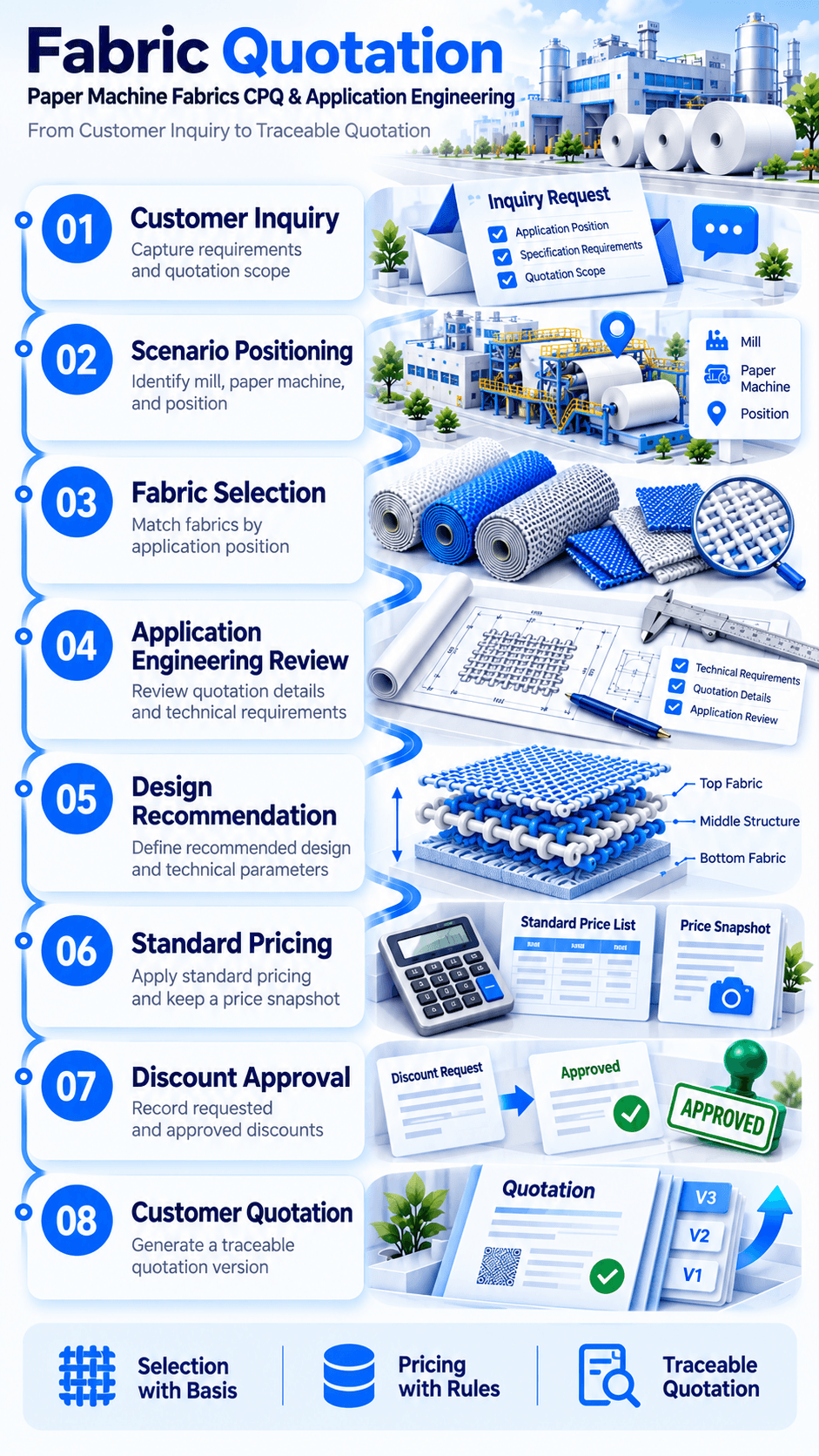
- 1. Customer RFQStart from the customer's requirements.
- 2. Mill / Machine / PositionEstablish the operating context.
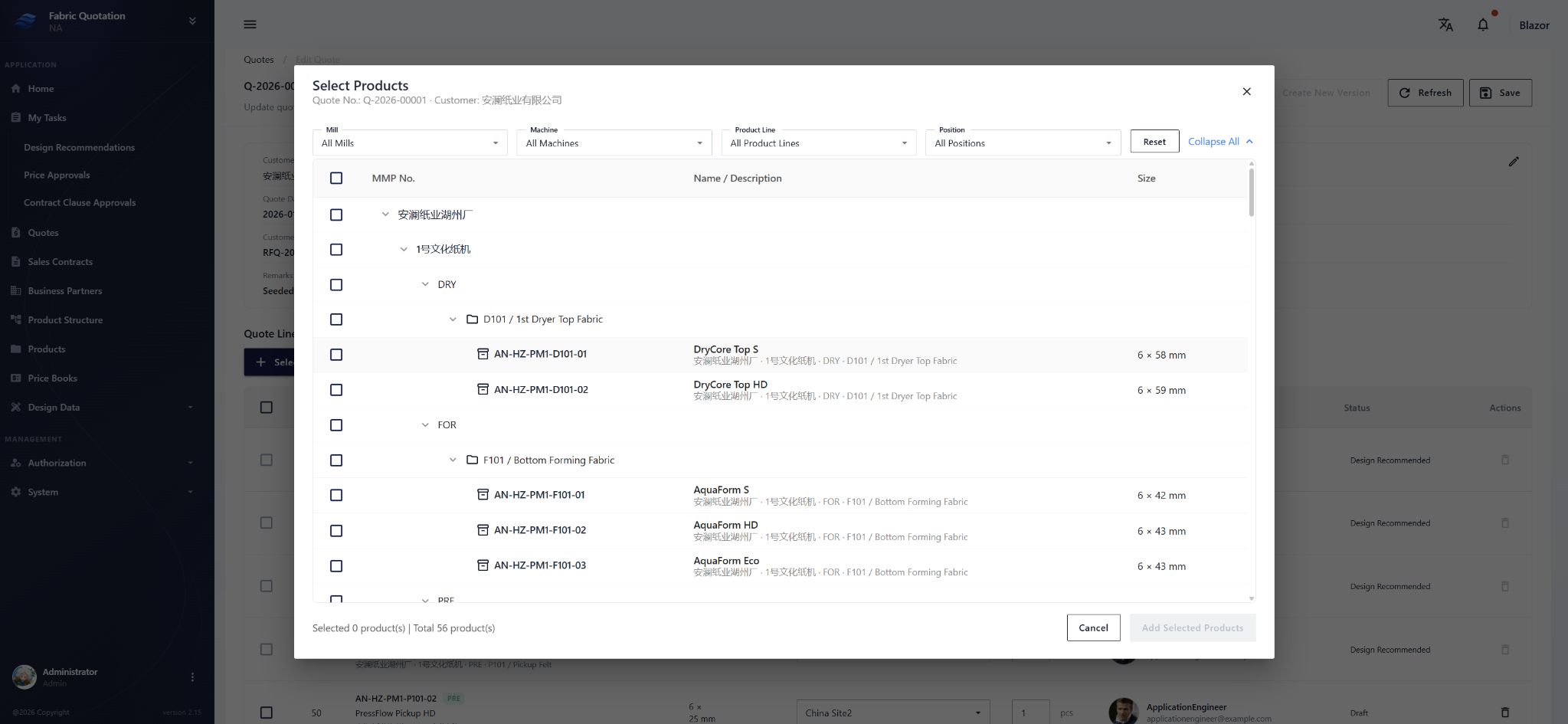
- 3. Fabric SelectionSelect products for the relevant positions.
- 4. Application EngineeringReview each quotation line.
- 5. Design RecommendationComplete the technical configuration.
- 6. Standard PricingApply pricing and preserve a snapshot.
- 7. Discount ApprovalReview the requested commercial terms.
- 8. QuotationPrepare a version with traceable decisions.
Sales, engineering and pricing decisions stay connected to the same quotation line, so the next person can continue with the information already captured.
Built Around the Way PMC Business Actually Works
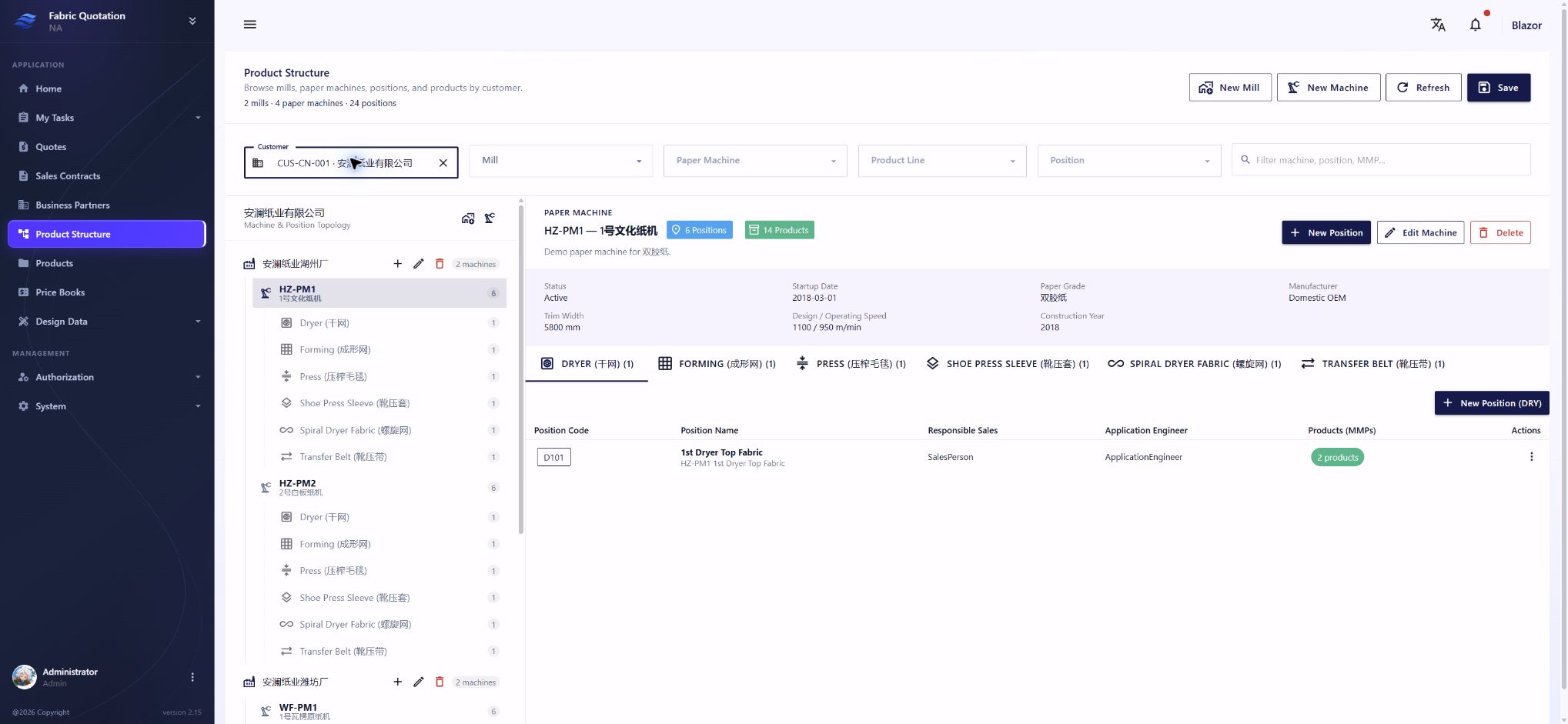
Fabric quotation goes beyond SKU selection. Each quotation starts within the customer’s real operating context:
Customer → Mill → Paper Machine → Position → Fabric
Browse the customer’s mills and machines, locate the position and select the associated fabric. Product-line grouping helps teams navigate forming, press and dryer applications without losing the machine context.
Each product also has a unique MMP number for identification and lookup.
Application Engineering Built into the Quotation Process
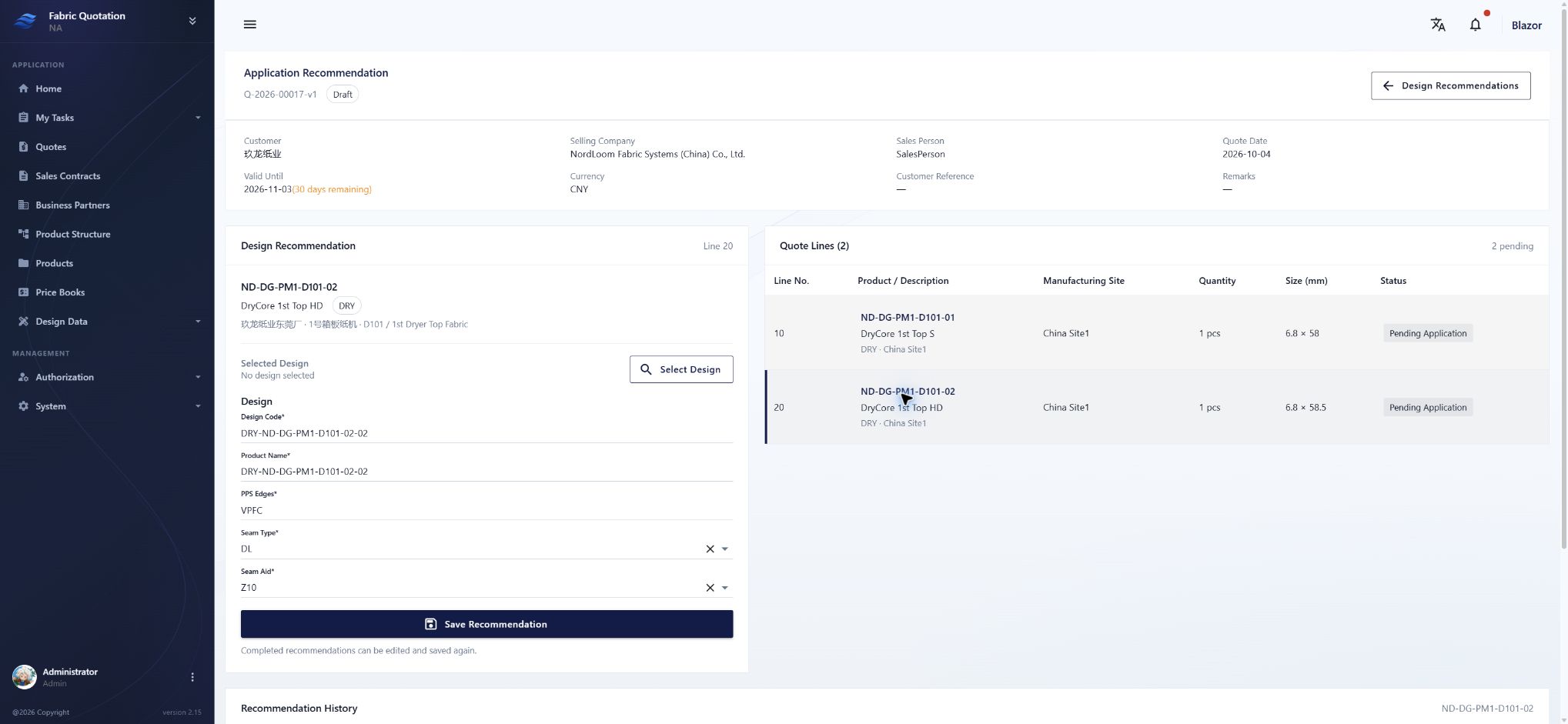
Move technical review into the quotation itself. Sales can submit quotation lines to Application Engineering instead of repeatedly exchanging parameters through Excel, email or Teams.
Application engineers can:
- Review machine and position information.
- Select or recommend the fabric design.
- Complete product-specific technical parameters.
- Record engineering recommendations.
- Return the completed design to Sales for pricing and quotation preparation.
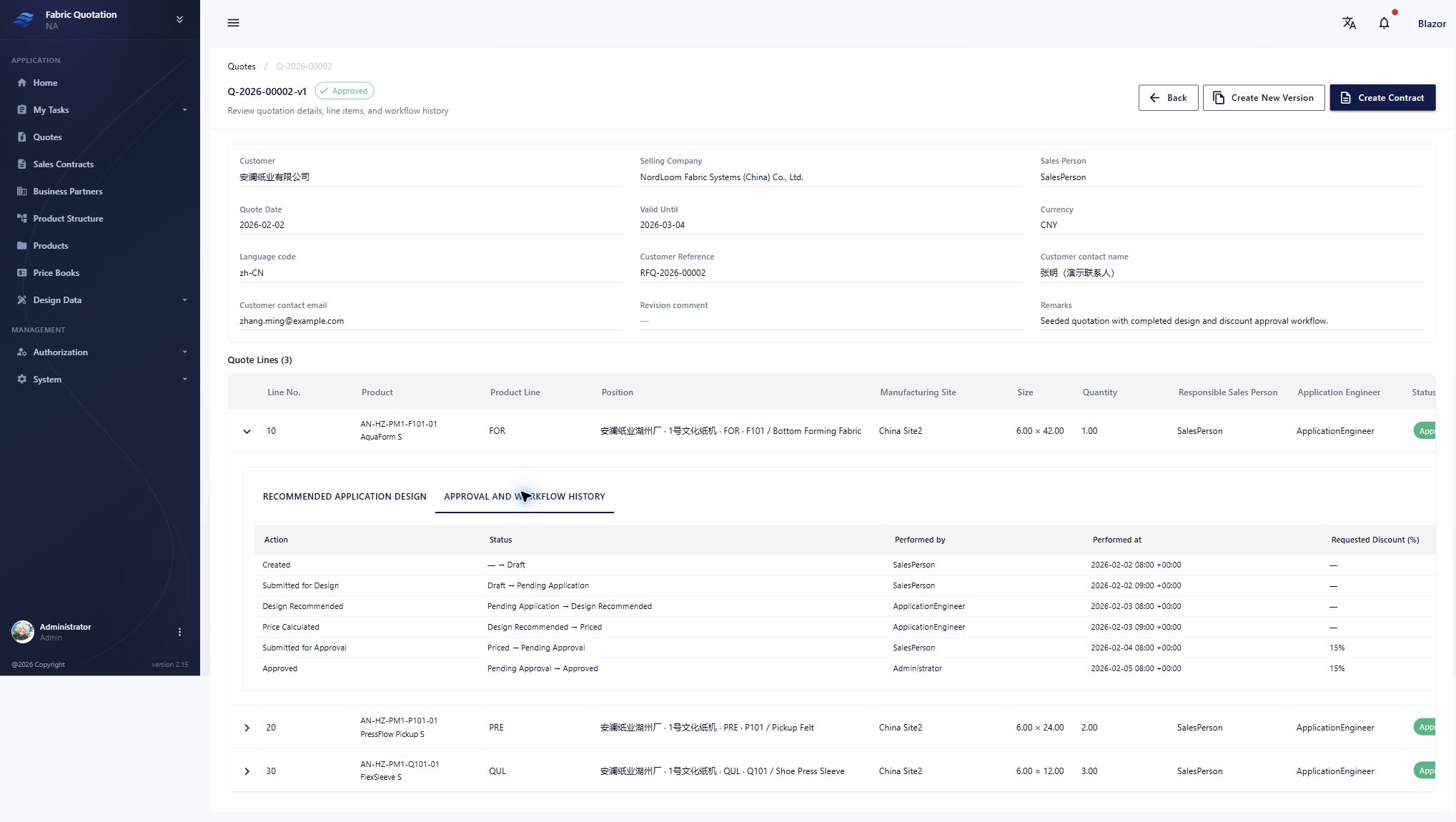
- Preserve design decisions with the quotation’s history.
This engineering handoff is a core difference from generic CPQ: the technical recommendation remains attached to the product and quotation it supports.
Flexible Technical Parameters for Different Fabric Families
Different product lines need different engineering information. Administrators can configure technical fields, sections, validation rules and option lists for:
- Forming Fabrics
- Press Felts
- Dryer Fabrics
- Shoe Press Sleeves
- Top Belts
- Additional product families as requirements evolve
Add or adjust technical parameters without redesigning the application’s core structure. When a field is retired, its historical quotation values remain available.
Controlled Pricing and Discount Management
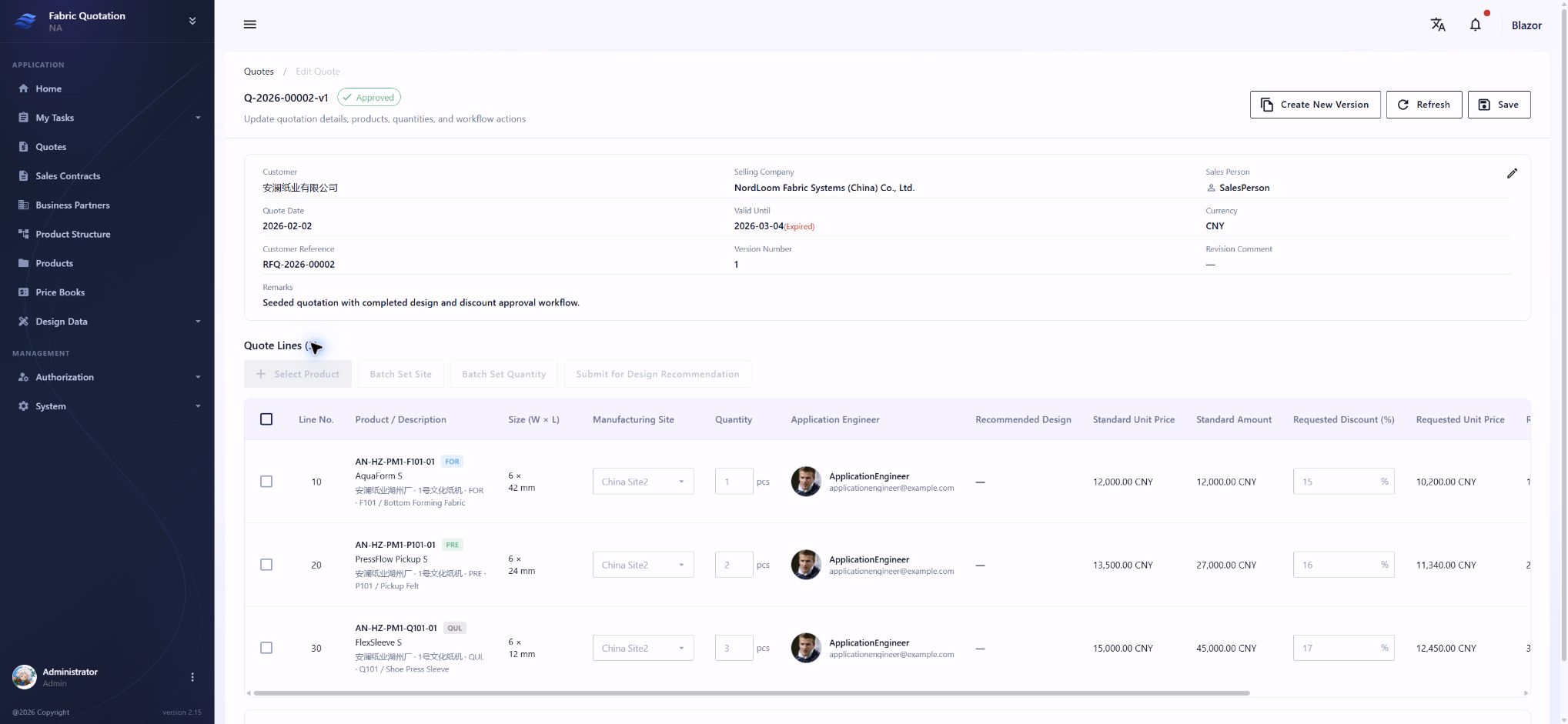
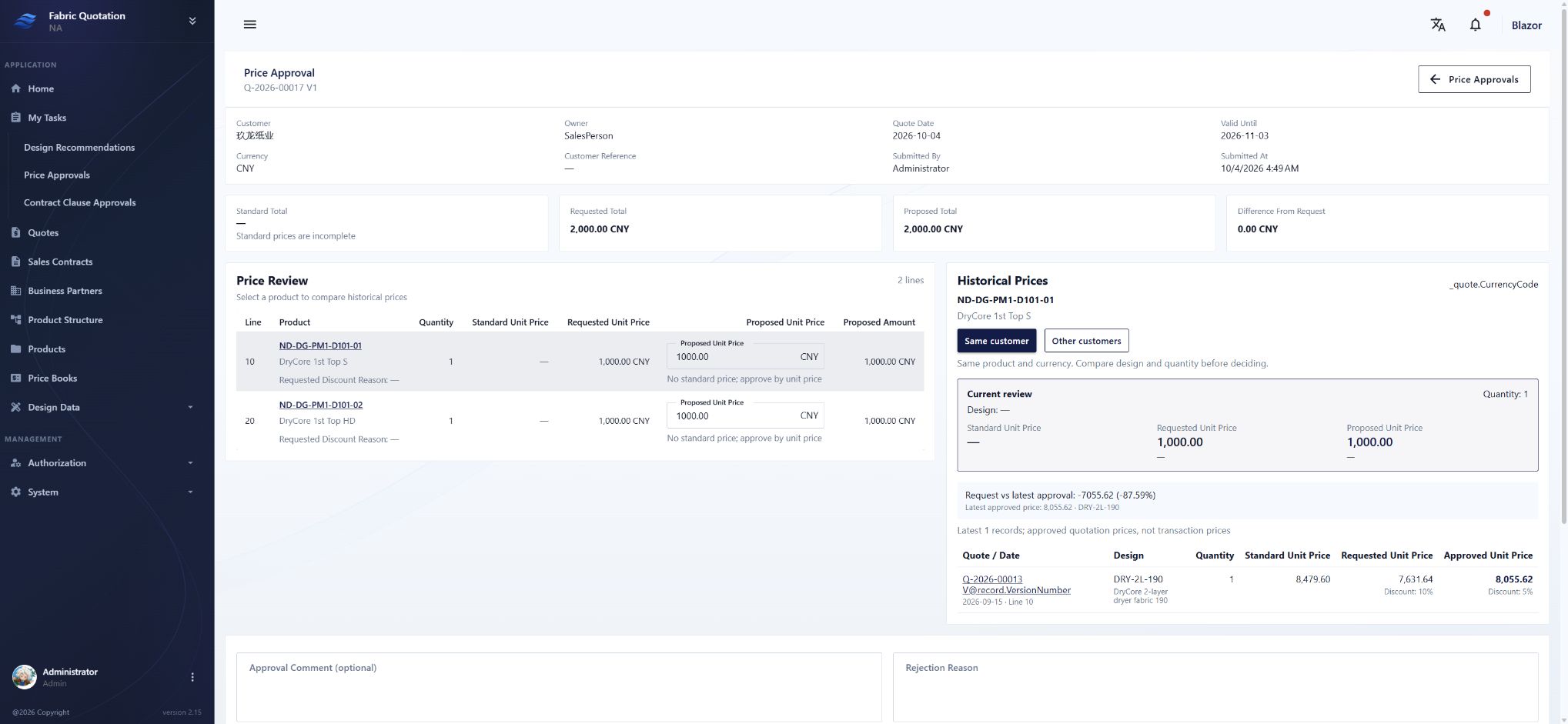
Sales can work efficiently without losing pricing control. Connect the recommended design to standard pricing, then keep the requested discount and approved discount separate.
- Maintain standard pricing by manufacturing site and design.
- Use a shared quotation currency across all lines.
- Preserve the Standard Unit Price snapshot for each quotation version.
- Record requested discounts and the reasons behind them.
- Record approved discounts and approval decisions.
- Review approval history and compare historical prices across quotation versions.
Changes to current pricing do not overwrite the price snapshots behind earlier quotations.
Every Quotation Version Remains Traceable
When technical configuration, pricing or commercial conditions change, create a new quotation version while preserving previous decisions.
For example, Quote 2026-001 could progress through:
- V1 — Initial proposal: selected fabrics and the first technical recommendation.
- V2 — Revised design: updated parameters and the corresponding pricing.
- V3 — Approved discount: the agreed commercial proposal.
Review earlier versions to understand what changed. Workflow and audit history help teams trace who performed actions, approval decisions, historical pricing and engineering recommendations.
Business Value for Your PMC Team
- Faster QuotationsReduce repeated manual work between Sales and Application Engineering.
- Standardized EngineeringTurn engineering experience into a repeatable review and recommendation process.
- Controlled PricingKeep standard prices, requested discounts and approvals connected.
- Better TraceabilityRetain quotation versions and the decisions behind them.
- Centralized Product KnowledgeConnect customers, machines, positions, fabrics and technical designs.
- Scalable ProcessExtend technical parameters to additional product families as the business grows.
Explore the Product Workflow
Follow the workflow in these screens from the live demo.
Enterprise Ready
Choose a deployment approach that fits your IT environment:
- Private cloud or on-premise hosting with Docker-based deployment.
- SQL Server or PostgreSQL database support.
- Role-based access control for sales, engineering and approval responsibilities.
- Audit history and quotation workflow records.
- Configurable product and design parameters.
- An API foundation for integrations scoped to your business needs.
Technical Details
The application uses .NET 10, Blazor Server, MudBlazor and Entity Framework Core. Clean Architecture separates domain, application, infrastructure and UI responsibilities, with Mediator, FluentValidation and Mapster supporting application use cases.
A reusable dynamic-field framework provides templates, field definitions, validation and historical values for product and design data. Docker deployment and automated tests support repeatable delivery.
Designed to Work with Your Existing Systems
Fabric Quotation can operate independently. Its integration-ready architecture also provides a foundation for project-specific connections to:
- ERP and CRM
- Customer and product master data
- Pricing systems
- Document management
- Authentication and SSO
Integration requirements, data mappings and authentication are agreed during implementation. Specific connectors are delivered according to the agreed project scope.
Start with a Focused Pilot
Validate the workflow with real quotations before expanding. A pilot implementation can start with:
- One product line
- Selected customers
- Several paper machines
- Existing product master data
- Current pricing rules
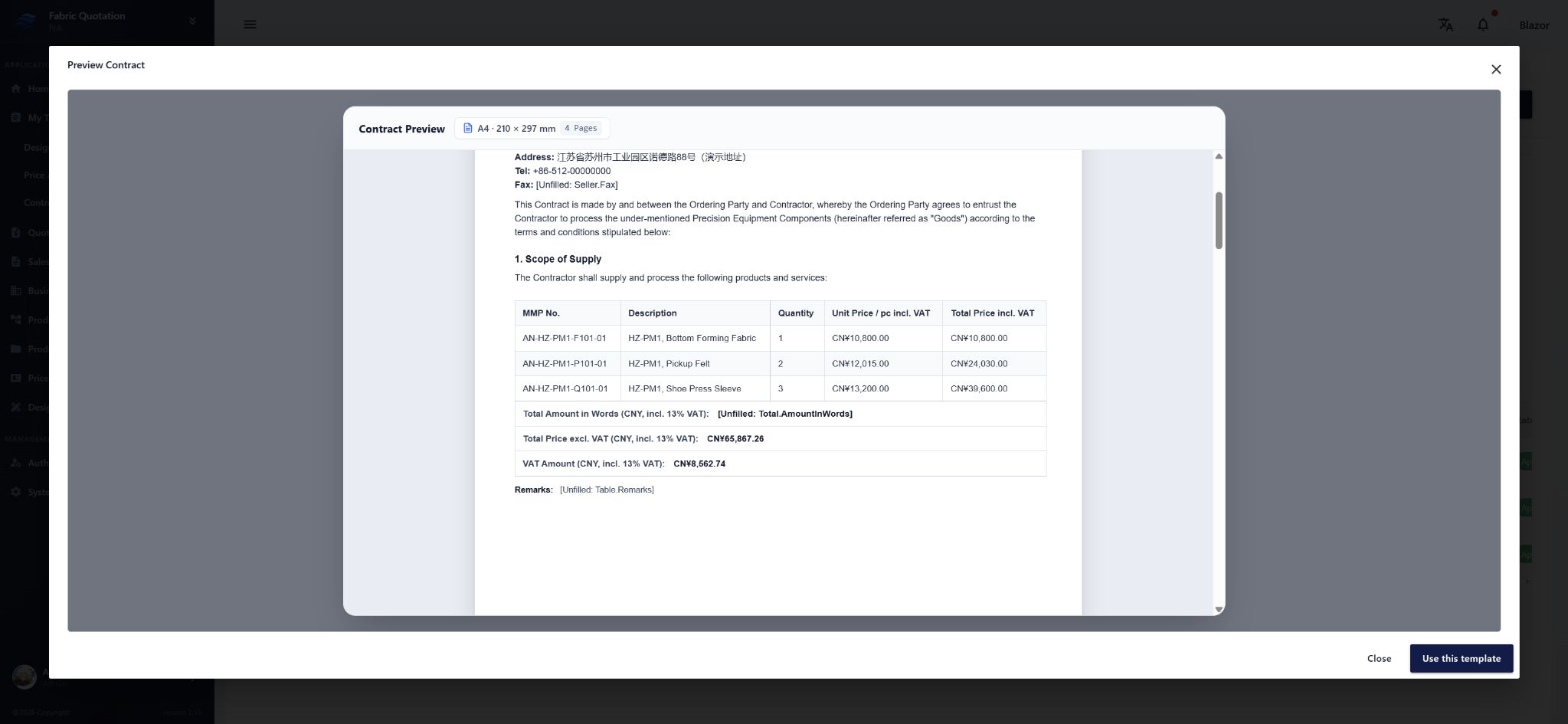
- One quotation or contract template
Use the pilot to check the engineering handoff, pricing control and approval process with your team, then decide where to expand.
See How Fabric Quotation Works with Your PMC Sales Process
If your sales and application engineering teams rely on spreadsheets, email and manual handoffs, see how a shared workflow can connect fabric selection, technical recommendations, pricing and quotation approvals.
Bring one product line and a representative quotation process. We can walk through the workflow and discuss a focused pilot for your business.
Share on WeChat